Showing posts with label Annie Dillard. Show all posts

Friday, December 13, 2013

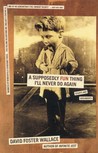
A Supposedly Fun Thing I'll Never Do Again

A Supposedly Fun Thing I'll Never Do AgainA Supposedly Fun Thing I'll Never Do Again by David Foster Wallace
My rating: 4 of 5 stars

This keenly observed series of essays encompasses tennis in Tornado Alley, television's effect on fiction, the films of David Lynch, the Illinois State Fair, and a superbly snide summary of a supposedly fun Caribbean cruise.

If you read nothing else in this collection, read the title essay to see David Foster Wallace (DFW) at his best. "A Supposedly Fun Thing" takes on the cruise industry with hilarious observation. DFW promptly rechristens his ship the Nadir, finds his liberal sensibilities tested by benefiting from the servitude of the cruise staff, wonders at the on-board entertainment, and makes witty and crushing observations about his fellow passengers in his trademark footnotes. He's erudite and clever, and it's easy to see how he earned his towering literary reputation.

In "Getting Away From Already Pretty Much Being Away From It All," DFW turns a supercilious eye toward the Illinois State Fair. His self-consciously acquired distance from his home state is punctured by the refreshing (and too-brief) presence of his foul-mouthed friend, whom he refers to only as Native Companion. His account of a dangerous baton-twirling competition is especially funny and worthwhile, and I think this is the second best of the lot.

"Derivative Sport in Tornado Alley" does what the very best essays do - blend two seemingly disparate topics with panache. You can lose yourself in his virtuoso language, which effortlessly blends ten-dollar words with expletives for humorous effect.

The essay "David Lynch Keeps His Head", which documents the making of Lost Highway, is strongest when DFW steers clear of film criticism (his tastes tend to the obscure and overly arty) and simply details the oddities of a Hollywood movie set (I mostly enjoyed reading about DFW's disdain for actor Balthazar Getty, which seemed pettily personal but in keeping with DFW's writing persona).

I find DFW's East Coast hyper-referentialism and snark sometimes off-putting (the worst offender, "E Unibus Pluram: Television and U.S. Fiction", also feels dated, penned before the cable boom enriched TV and started trends toward more serialized storytelling), but his pose of detachment and gift for ironic observation makes it worthwhile to wade through the pretentious bits. However, I rarely find his worldview as compelling or as deep as his prose.

DFW is at his most powerful when aiming his formidable vocabulary at people and places: his true talent is in describing and classifying people with the precision of an lepidopterist with a flock of butterflies. He is much less interesting when venturing into analyses of art or literature - it's easy to get lost in his school-of-criticism buzzwords and East Coast irony. For essay lovers who are already fans of Annie Dillard's peerless Pilgrim at Tinker Creek, Michael Chabon's Maps and Legends, or Joyce Carol Oates' excellent anthology The Best American Essays of the Century, you shouldn't overlook David Foster Wallace.

So Quotable:

"I had gotten so prescient at using stats, surface, sun, gusts, and a kind of stoic cheer that I was regarded as a physical savant, a medicine boy of wind and heat, and could play just forever, sending back moonballs baroque with spin. Antitoi, uncomplicated from the get-go, hit the everliving shit out of every round object that came within his ambit, aiming always for one of two backcourt corners. He was a Slugger; I was a Slug." - "Derivative Sport in Tornado Alley"

"They made no sense. Houses blew not out but in. Brothels were spared while orphanages next door bought it. Dead cattle were found three miles from their silage without a scratch on them. Tornadoes are omnipotent and obey no law. Force without law has no shape, only tendency and duration." - "Derivative Sport in Tornado Alley"

"Television is the way it is simply because people tend to be extremely similar in their vulgar and prurient and dumb interests and wildly different in their refined and aesthetic and noble interests." - "E Unibus Pluram"

"Indifference is actually just the '90s' version of frugality for U.S. young people: wooed several gorgeous hours a day for nothing but our attention, we regard that attention as our chief commodity, our social capital, and we are loath to fritter it." - "E Unibus Pluram"

"I have seen sucrose beaches and water a very bright blue. I have seen an all-red leisure suit with flared lapels. I have smelled what suntan lotion smells likes spread over 21,000 pounds of hot flesh. I have been addressed as 'Mon' in three different nations. I have watched 500 upscale Americans dance the Electric Slide." - "A Supposedly Fun Thing I'll Never Do Again"

Wednesday, October 23, 2013

The Child That Books Built

The Child That Books Built: A Life in ReadingThe Child That Books Built: A Life in Reading by Francis Spufford
My rating: 5 of 5 stars

A lifelong reading addict guides us through not only his own autobiographical journey, but also through the wild geography of children's literature, from Little House on the Prairie to Narnia and beyond.

This has to be hands-down my favorite books about the reading life, which is why I reread it this year. It's not your typical autobiography, nor your typical reading life journey. Spufford is much more interested in the movement of the human mind from childhood to adolescence, and he brings a panoply of deeply literary references to bear on the subject. His style is reminiscent of my other favorite essayists, particularly Annie Dillard (if you haven't read her and love gorgeously written science essays, start with Pilgrim at Tinker Creek, though her other collections are also excellent).

Spufford starts with a dense discussion of the universal psychology of child development, moving from Freud and Jung to Piaget. Each of the next three sections is about a different type of encounter with literature - the pure joy of entering Narnia, with a thoughtful and nuanced take on C.S. Lewis's fervently sensualist Christianity; an Englishman's perspective of America, informed by encounters with Laura Ingalls Wilder and To Kill a Mockingbird; and an adolescence where his reading arc moved from children's literature to science fiction (like Ursula K. Le Guin's The Left Hand of Darkness) to the metafiction of Jorges Luis Borges and Italo Calvino (two of my favorite writers).

In fact, his childhood reading life so closely mirrors my own that it felt spooky to read the journey of someone who was born a continent and an ocean away, who is roughly the age of my parents, and male - but who read the same books with many of the same emotions. (He only read other books after the discovery of Narnia, he says, because there were only seven Narnia books and he couldn't be constantly rereading them.) Of course, I did not have a sister with a devastating disease, either, or have to wrestle with the complex guilt he felt at his instinctive reaction to her illness.

Spufford is what Nancy Pearl would call a story reader, primarily in it for plot, coming to the pleasures of more subtle adult fiction where character and language overcome story and setting much later, and never as a native to the territory. I'm similarly in it to be carried along by a great story or taken to a fascinating new world. Thanks to Spufford I picked up Arthur Ransome's wonderful Swallows and Amazons (it beats even the first The Boxcar Children hollow as a story of childhood independence), and discovered the alternative-history England - chillingly wolf-infested - of Joan Aiken.

It is tempting to simply spin out title after title of the great books he discusses with such clarity and insight, but I'll resist and instead pepper you with quotations. I was amazed, since it's been so long since I first read this, at how many of his insights and opinions I have internalized without remembering their source. One of the dangers of reading great essayists: your mental landscape will never be the same.

Quotable:
On learning to read
The formerly sacred nature of books

"Compared to the books I was used to, and was growing out of, grown-up literature seemed spectacularly open-ended. I would read a few pages, and there would seem to be no edges and limits to what was going on; no sense of an evolving shape, and so no urgency, and no particular reason to read on. Of course, the reformulating jump into adult fiction consists exactly of a retuning of your reading mind to those subtler, wider, but still ultimately decisive cues to meaning that a writer for adults constructs in the expectation that the person reading will bring an active, participatory judgment to the task. No book is truly open-ended." - 170

On science fiction genre reading in his teens:
"Some of it was frankly bad. Some of it was good on one point only - one idea, one invention - and the whole of the rest of the novel existed only as a scaffolding to hold that one good thing in place. And some of it was 'good' in a purely efficient way, because it worked out a daft premise sleekly. So what. Who cares. Good books are so often committed to self-denial of one sort or another. They make their fictional world real by making it austere; they hammer events into proportion, and subdue them with probabilities." - 178

"Sensible, probable books keep sending you back where you came from. It's the wild and tacky ones that let you see further into the world you do not yet know. It's the books that dispense with rigor and proportion that let your imagination billow out, and go exploring. They give you time, space, empire, power; an existence answerable to your wishes as your own really is not. Their freedom from what really is becomes your freedom, very directly. They give you scope." - 178