Growing up, I read Florence King's column because my parents had a subscription to The National Review. She was my favorite part of the entire magazine, mostly because of her way with words. I realize now how she reminds me of Oscar Wilde, Ambrose Bierce, P.G. Wodehouse, and a touch of David Sedaris.
And I wish that I had encountered her memoir, Confessions of a Failed Southern Lady, years ago. I heard of this book only because she died in the first week of 2016 at age 80. She makes misanthropy funny, and is scathingly honest. She's also a conservative feminist, which is a rare bird indeed.
Don't expect to read a placid 1950s coming-of-age story a la The Life and Times of the Thunderbolt Kid (a book I truly enjoyed, BTW). Do expect sex. LOTS of sex. And a woman whose family overlooks Christmas only because of "the din made by the Different Drummer Corps that marched back and forth across the parade grounds of our minds" (205).
Be prepared, too, for a stunning third act that turns this light fluff of a biography into something more. It is poignant, sad, and cathartic. I'm adding Florence King into my list of favorite writers, and look forward to reading more of her work.
So Quotable:
On her parent's first meeting: "It was a bad start but the gin helped." - 17
"Expecting Granny to stay away from an unformed blob of female material was like expecting a cobra to stay away from a flute." - 29
"A man who wears a tuxedo while emptying the garbage at four A.M. is bound to have strange children." - 33
"Today I admire her lack of vocation for motherhood, but at four I was convinced that she was trying to murder me." - 42
"Whether or not I went crazy is impossible to say; a maniac could hide in my family as a leaf can hide in a forest." - 45
"Dimly I sensed that a female with a personality like mine has to make sure that she looks and smells good at all times, or as Henry Adams put it: 'Those who study Greek must take pains with their dress.'" - 81
Out of all the sports after joining the Marines: "I picked riding because it gave me a chance to sit down." - 148
"I inadvertently encouraged him by laughing - at him - but incapable of discerning the difference, he soon believed himself to be the heir of Swift and Wilde." - 240 (Spoken like a true misanthrope!)
Showing posts with label P.G. Wodehouse. Show all posts
Showing posts with label P.G. Wodehouse. Show all posts
Tuesday, July 19, 2016

Friday, November 8, 2013
Something Fresh
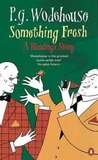 Something Fresh by P.G. Wodehouse
My rating: 4 of 5 stars
Trouble and romance are in the offing when two adventurers descend upon Blandings Castle incognito - all because of Lord Emsworth, an innocent kleptomaniac who steals a collector's rare treasure.
Ashe Marson and Joan Valentine meet by accident and you know it will soon be love. But the two young people, both starving writers, find themselves at odds when they independently accept the challenge of retrieving a precious scarab for an American collector. They infiltrate Blandings' complex caste system of the servants, braving a keenly suspicious secretary and Lord Emsworth's reckless use of firearms.
Meanwhile, young muttonhead Freddie Threepwood (an equal to Bertie Wooster in lazy amiability, and with much the same taste in literature), is engaged to the American collector's daughter, Aline. But he has an energetic rival who plans on wooing Aline right out from under Freddie's nose....
The coveted Egyptian scarab (a worthy rival to the silver cow creamer in its ability to act as a cursed object) that drives the plot in the first of the Blandings Castle stories. Wodehouse showcases his usual effortless wit and introduces the Blandings crew, though Ashe and Joan steal center stage with their (non-malicious) plotting. We are treated to a glimpse of the stratified serving class and a very funny conversation about women's suffrage where Joan compares Ashe's chivalry to a dead mouse her proud cat might bring her as a gift. The romances are sweetly credible - especially Joan and Ashe, who are each other's equals as well as soulmates.
The third person narration gives Wodehouse scope to move into different perspectives, but his wonderful storytelling voice remains true (though this isn't his most cohesive plot). The best thing to follow Wodehouse with is obviously more Wodehouse, so The Code of the Woosters, featuring another MacGuffin plot and country manor setting, may be right up your alley.
Quotable:
"Collecting, as Mr. Peters did it, resembles the drink habit. It begins as an amusement, and ends as an obsession." - 50
"Oh, I've nothing to say against Freddie. He is practically an imbecile and I don't like his face, but apart from that he's all right." - 61
Tuesday, August 20, 2013
Aunts Aren't Gentlemen

My rating: 4 of 5 stars
This is the final Jeeves book, and though it still sparkles with Wodehouse's usual wit, the wheels of the plot move with less complexity than they did in The Code of the Woosters or The Inimitable Jeeves (which contains "The Great Sermon Handicap," possibly the best Jeeves short story). Aunt Dahlia only gets a scene or two in her best form, plus Bertie's usual chucklehead Drones friends are noticeably absent and our hero seems a bit lonely on his solitary adventures. (Instead of staying in an overpopulated country house, Bertie has a cabin of his own.) Bertie's resigned despair at being unexpectedly engaged to a woman who seeks to ban his smoking and drinking is muted as a result.
Still, the inconvenient cat makes for a very funny plot device, and Wooster lovers will eat this one up like Anatole's cooking.
Monday, August 12, 2013
The Code of the Woosters
 The Code of the Woosters by P.G. Wodehouse
My rating: 5 of 5 stars
A coveted silver cow-creamer drops hapless gentleman of leisure Bertie Wooster into the middle of two engaged couples, an incriminating notebook, an insufferable Scottie, and blackmail - in short, a situation impossible for any brain but Jeeves' to unravel.
Bertie's troubles begin with "a sort of silver cow with a kind of blotto look on its face", which Aunt Dahlia needs for her collector husband. But when the cow-creamer is usurped and a friend's engagement threatens to unravel, Bertie springs into action. By the end of an eventful day in the country, Bertie manages to get engaged to two separate girls, join a fistfight with an aspiring dictator, and wind up on the wrong end of the law. Fortunately Jeeves is there to shimmer in and smooth everything out.
Wodehouse one-ups Chekhov's gun with a silver cow creamer and a loaded notebook - two items that both go off by the end of the day. More than once. As complex and funny as the plots are, the real pleasure in reading any Wodehouse novel is his prose. He has a silver ear for getting just the right phrase, piling up slang and classical allusion in a hilarious way that may be imitated but never bettered.
For other humorists known for being quotable and witty, start with Dorothy Parker Stories by Dorothy Parker, or James Thurber's short stories, especially "The Secret Life of Walter Mitty" or "The Catbird Seat."
Quotable:
"I could see that, if not actually disgruntled, he was far from being gruntled" - 3
"Aunt Agatha, who eats broken bottles and wears barbed wire next to the skin." - 4
"There are moments, Jeeves, when one asks oneself, 'Do trousers matter?'"
"The mood will pass, sir."
"Prismatic is the only word for those frightful tweeds and, oddly enough, the spectacle of them had the effect of steadying my nerves. They gave me the feeling that nothing mattered."
Tuesday, May 21, 2013
The Disreputable History of Frankie Landau-Banks
UPDATE: I helped create a trailer for this book! You can view it here.
 The Disreputable History of Frankie Landau-Banks by E. Lockhart
My rating: 5 of 5 stars
Frankie Landau-Banks goes from "Bunny Rabbit" to criminal mastermind during her sophomore year at the exclusive Alabaster Prep boarding school.
When Frankie starts dating Matthew Livingston, she feels that she has been given a window into his world of confident privilege and power. And she desperately wants to belong in her own right, not just as a pretty girl the boys underestimate. She discovers the existence of the male-only Loyal Order of the Basset Hounds and secretly begins pulling their strings, orchestrating larger and more elaborate pranks.
This is one of my favorite YA books. Frankie is smart, her pranks are genuinely clever and funny, and she is as conflicted and occasionally insecure as any other ordinary high-school girl. Unlike most high school girls, though, she knows exactly what she wants and often has a good idea of how to get it. (This is also the book that introduced me to P.G. Wodehouse, for which I shall be eternally grateful.)
Written like an anthropological study (or a profile of the criminal mind at work), The Disreputable History chronicles one ambitious, smart girl's year of coming into her own. A book club or an English class could probably spend a quarter analyzing the power dynamics at play, Frankie's ideas about rebellion against the Panopticon, or how each character (male and female) represents a different response to patriarchy.
A few of my favorite quotes from the book:
The Disreputable History of Frankie Landau-Banks by E. LockhartMy rating: 5 of 5 stars
Frankie Landau-Banks goes from "Bunny Rabbit" to criminal mastermind during her sophomore year at the exclusive Alabaster Prep boarding school.
When Frankie starts dating Matthew Livingston, she feels that she has been given a window into his world of confident privilege and power. And she desperately wants to belong in her own right, not just as a pretty girl the boys underestimate. She discovers the existence of the male-only Loyal Order of the Basset Hounds and secretly begins pulling their strings, orchestrating larger and more elaborate pranks.
This is one of my favorite YA books. Frankie is smart, her pranks are genuinely clever and funny, and she is as conflicted and occasionally insecure as any other ordinary high-school girl. Unlike most high school girls, though, she knows exactly what she wants and often has a good idea of how to get it. (This is also the book that introduced me to P.G. Wodehouse, for which I shall be eternally grateful.)
Written like an anthropological study (or a profile of the criminal mind at work), The Disreputable History chronicles one ambitious, smart girl's year of coming into her own. A book club or an English class could probably spend a quarter analyzing the power dynamics at play, Frankie's ideas about rebellion against the Panopticon, or how each character (male and female) represents a different response to patriarchy.
What to read after you're finished:
The Boyfriend List: 15 Guys, 11 Shrink Appointments, 4 Ceramic Frogs and Me, Ruby Oliver by E. Lockhart - for your next fix of clever, feminist chick lit.
The Interventionists: Users' Manual for the Creative Disruption of Everyday Life, edited by Gregory Sholette - "interventionists" create art to bring awareness to issues of injustice (Lockhart cites this in the afterward).
The Code of the Woosters by P.G. Wodehouse - For a hilarious look into the machinations of the Old Boys' Club by "a prose stylist of such startling talent that Frankie nearly skipped around with glee when she first read some of his phrases." Amen.
Team Human by Justine Larbalesteir - another YA writer who consistently writes strong and believable female heroines.
A few of my favorite quotes from the book:
- "Secrets are more powerful when people know you've got them," said Mr. Sutton. "You show them the tiniest edge of your secret, but the rest you keep under wraps."
- "It had been, she felt, a dumb event preceded by excellent invitations."
- "She wasn't a person who needed to be liked so much as she was a person who liked to be notorious."
- "Frankie did not accept life as it was presently occurring."
- “It is better to be alone, she figures, than to be with someone who can’t see who you are. It is better to lead than to follow. It is better to speak up than stay silent. It is better to open doors than to shut them on people.”
Thursday, May 9, 2013
The Convenient Marriage

My rating: 4 of 5 stars
Horatia is no shy beauty, in spite of her stammer and the fact that she is only seventeen. The scene where she basically proposes marriage to the male lead is funny and classic Heyer. Once wed, Horatia makes good use of Lord Rule's fortune, racking up gambling debts and buying outrageous hats and gowns. She's soon the Talk of the Town, and slowly her honesty and charm begin to woo the heart of her faithless husband.
Unfortunately, Horatia doesn't realize that her marriage has created new enemies and stirred the interest of Lord Rule's oldest foe: the suave Lord Lethbridge, who sees a way to get revenge on the husband through his new bride.
This Heyer book rarely disappoints, and provides duels and trickery worthy of The Three Musketeers by Alexandre Dumas or The Scarlet Pimpernel by Baroness Orczy. There is one duel in particular that is exciting and atmospheric (though given the villain's truly awful crimes I wish it had ended more lethally).
Unfortunately, there is so much plot that we get very few scenes between the unfortunately nicknamed "Horry" and Lord Rule, so I found the chemistry lacking a bit. It would have helped me buy the romance between a naive 17-year-old and a jaded 35-year-old.
Horry's ne'er-do-well brother Pelham and his bumbling attempts to help her recover a lost piece of jewelry reminded me of a drunker version of Bertie Wooster (which may have been what Heyer intended since she named the brother Pelham, which is author P.G. Wodehouse's first name).
In short, there is enough romance, action, and humor to appeal to the most discerning reader!
(And yes, that is the ridiculous cover of my book. Oh 1975, you have a lot to answer for.)
Monday, March 4, 2013
Jeeves Again
 The Inimitable Jeeves by P.G. Wodehouse
My rating: 5 of 5 stars
Bertie Wooster's tranquil existence is continually disrupted by his lovelorn friend Bingo Little, the fearsome Aunt Agatha, or an engagement with a strong-willed woman - fortunately, Jeeves is always present to smooth over difficulties.
This is probably the best collection of Jeeves stories I've read so far. They are sequenced chronologically, though technically separate stories. I found myself laughing out loud in public (sorry if you came across me and were frightened) at Wooster's turns of phrase. Jeeves doesn't walk into a room; he 'shimmers in.' Grown men don't leave a club, they 'toddle.' People don't scarf their food, they 'shove their heads down' and go for it. Wooster's narration is charming and silly, as Wooster himself is.
The dialogue is likewise brilliant: "'What ho! What ho! What ho!' I said, trying to strike the genial note, and then had a sudden feeling that that was just the sort of thing I had been warned not to say." Bertie is always overestimating his own ability to express himself, and is usually unintelligible to other characters because of his frequent use of slang. (And Wodehouse can get dialogue and narration to tell two different stories like no other writer.)
For reading when you're sad, or for reading when you're happy, or reading when you don't know what you feel, Wodehouse has no equal.
Thursday, November 8, 2012
Jeeves in the Offing

Jeeves in the Offing by P.G. Wodehouse
My rating: 4 of 5 stars
Bertie Wooster braves a visit to his aunt's house in the teeth of a fearsome old schoolmaster, an unexpected fiancée, a kleptomaniac swain, and an alienist disguised as a butler. When a higher power is needed to straighten the topsy-turvy affairs at Brinkley Court, the vacationing Jeeves proves himself indispensable as usual.
Tuesday, November 6, 2012
On Time Travel
 To Say Nothing of the Dog by Connie Willis
My rating: 5 of 5 stars
An elusive Victorian gewgaw draws a time-traveling historian into the slippery nets of history, and the fate of the universe may turn on a drowned cat, a woman's indecipherable diary, an unknown Mr. C, and the bombed-out church at Coventry - to say nothing of the bulldog. Anyone who loves Agatha Christie's puzzles, P.G. Wodehouse's starchy butlers and silly gentlefolk, or Jerome K. Jerome's Three Men in a Boat will appreciate this cheerful romp.
View all my reviews
Subscribe to:
Posts (Atom)